Charcoal burning has a rich history here in the UK and across the world. Archaeological evidence has shown that man was making charcoal as far back as 6000BP (before present). Many of the metal working processes such as bronze and iron smelting rely on the heat generated by charcoal to work.
In this potted history we will cover the three main methods of charcoal production and explain how they differ but also how they are intrinsically linked by the life of the wood colliers.
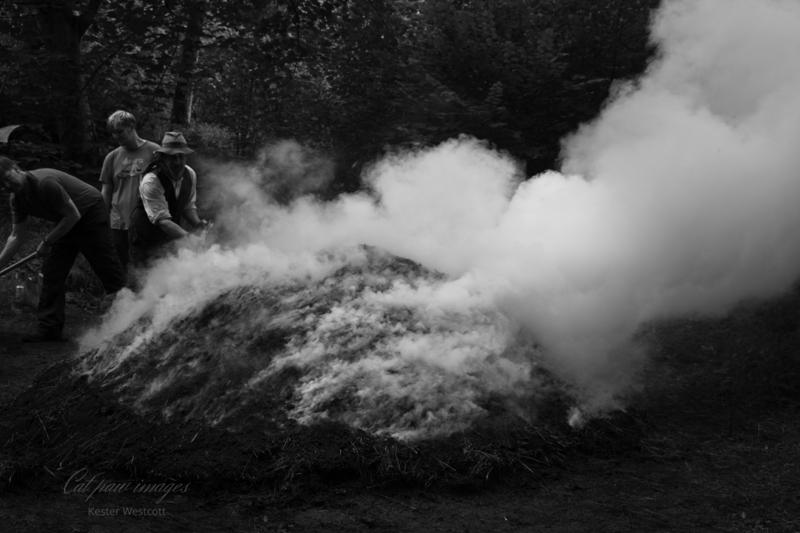
Traditional earth burns use timber piles covered with soil and straw, carefully controlled over several days (up to a week). While only really carried out now for demonstration purposes the earth burn method of charcoal production was in some parts of the UK still going as late as the 1960’s.
Traditional earth burn is built using stacked timber and then covered in a mixture straw and soil, It is then lit from the centre and the burn progresses from top to bottom. the woodcollier opens holes up in the outside of the stack and slowly works their way down as the steam changes colour from white through yellow to blue they then cover the holes and open up below. The precess is very labour intensive and must be watched constantly else you can lose the lot.
To extinguish an earth burn you use copious amounts of water this is poured into holes within outside and the steam extinguishes the fire.
Once opened the charcoal is arranged in a snail shell shape and yet more water is used to extinguish any hot spots.
The process of an Earthburn can take anywhere between a couple of days and up to a week. In Europe earth burns are still carried out for demonstration purposes using anything up to 25 tonnes of timber.
Across the world charcoal is still produced using this method or using a pit system that works in a similar way.
During the industrial revolution far more charcoal was required so a new method was needed to produce that charcoal. This is where ring kilns came in.
They’re best described as a large drum with a and lots of chimneys which are used both exhaust steam and also to allow control amounts of air into the system.
The massive advantage of the ring kiln is it is much less labour intensive and far more controllable, with burns taking between 12 and 30 yours depending on the ring size and hight.
To load a ring kiln you first place vents under the ring at equal spaces you then build chimneys or runs of timber between these and the centre of the kiln where the Charge (kindling and small wood to light the fire) will be, you then you start to build a ring of timber round and over this to stop the timber that’s placed in above collapsing on top of it too early.
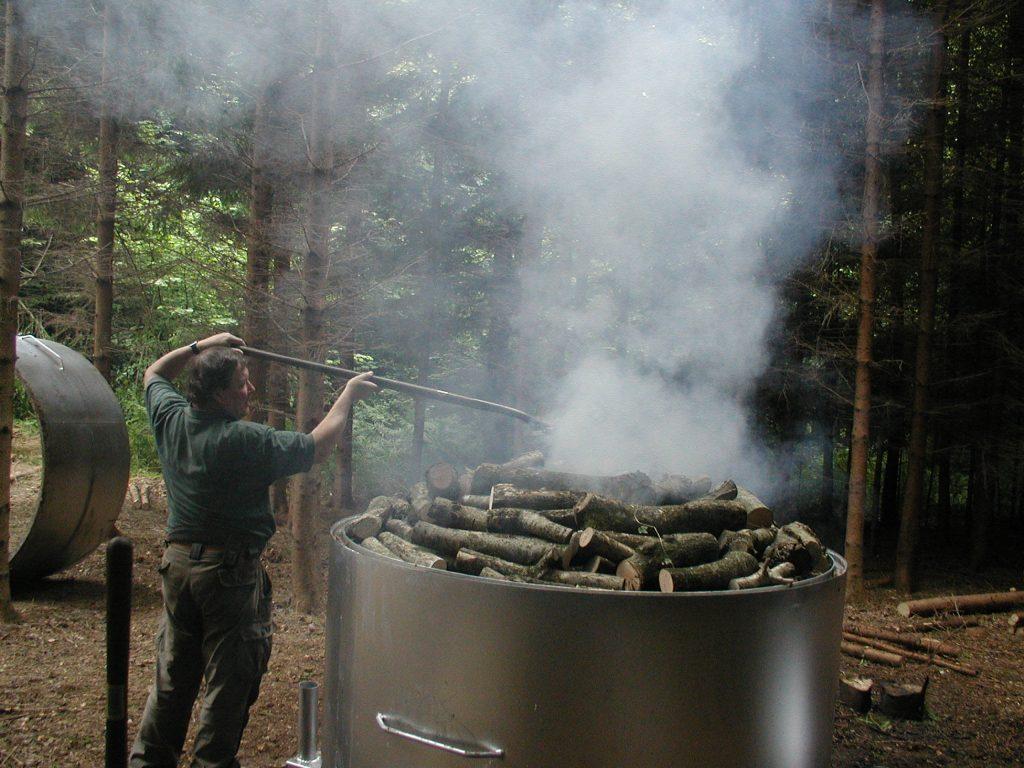
You then start to load from the outside using larger timber as you get into the centre the idea of this is that the timber won’t burn through or char too early, It won’t then become fine charcoal because the fire centre is superheating. It is then just a case of building your stack of timber within the ring all the way up above the top. With larger 8-foot rings it’s quite common to stack one on top of the other to produce a much larger burn, in this way you can produce upwards of 500kg per burn.
Once fired you then have to empty the burn by shovelling the charcoal out over the side this is hot dusty work and can take an hour or more.
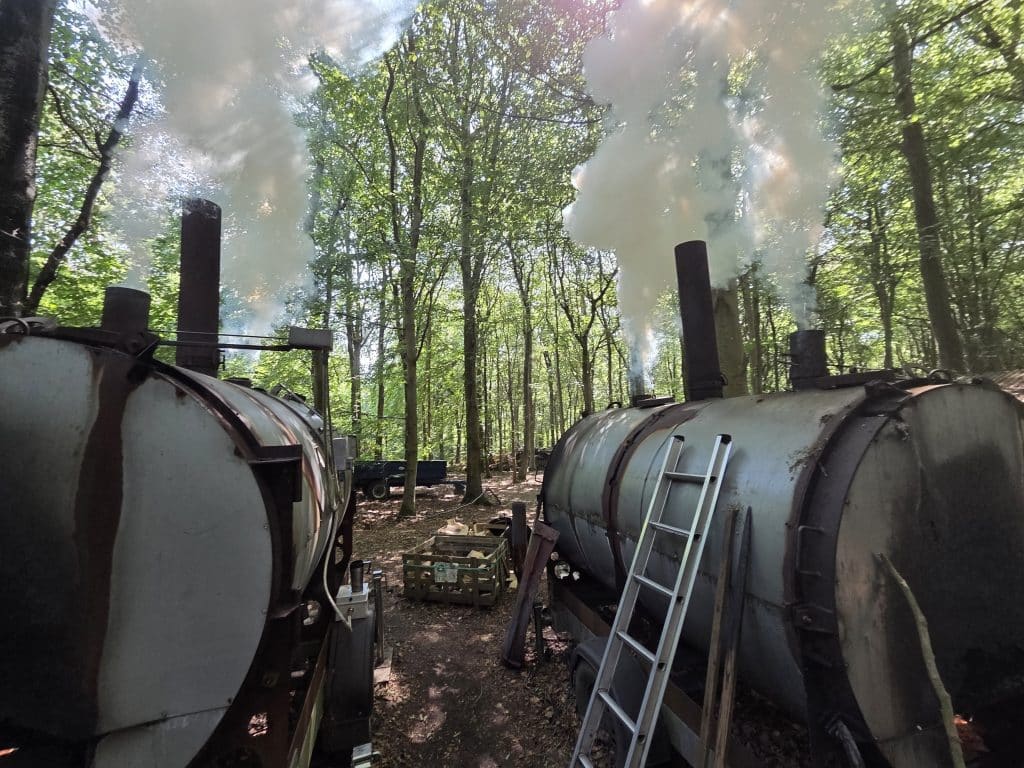
During the 20th century the retort system was developed initially used by companies like ICI to produce wood vinegar for creosote, they are now used far more commonly by smaller charcoal burners like ourselves.
Charcoal retorts are a far more efficient system which cooks the timber rather than burning it as you do with the older systems.
Today, many producers use modern retort systems, which heat the wood in a chamber using the wood gas for a cleaner, more efficient burn.
The main advantages for the retort system are:
A reduction in timber used – because a retort does not burn the timber but cooks it the losses are far less with a typical conversation rate of 4:1 meaning more charcoal for less wood
A reduction in pollutants – while much of what you see coming from a charcoal kiln is steam and nearly all of it is returned to the woodland there is still some gasses produced, in the retort system these are harnessed to run the burn further reducing the environmental affects
Time reduction – a typical retort cycle can be as little as 24hours from loading to bagging the charcoal meaning a more efficient way of working, some systems even allow for multiple batches of charcoal to be made in one cycle.
The disadvantages:
The cost of a charcoal retort can thousands of pounds with extra costs over time for seals etc.
Today, many producers use modern retort systems, which heat the wood in a chamber using the wood gas for a cleaner, more efficient burn.
New courses and dates available